Qwen3.5 is Alibaba's vision-language model family. It accepts an image and a text prompt and returns a text response. Two pretrained checkpoints are available:
| Alias | Parameters |
|---|---|
qwen3_5-0.8b | 0.8B |
qwen3_5-2b | 2B |
Qwen3.5 accuracy
Headline vision-language benchmarks (non-thinking mode) from the official model cards (0.8B, 2B):
| Benchmark | qwen3_5-0.8b | qwen3_5-2b |
|---|---|---|
| MMMU | 47.4 | 64.2 |
| MathVista (mini) | 58.6 | 73.9 |
| MMBench (EN v1.1) | 68.0 | 81.3 |
Qwen3.5 inference speed
Latency measured with Roboflow Inference on 1x NVIDIA L4, batch size 1, generating exactly 128 tokens with greedy decoding from a fixed prompt. Latency scales with output length, so use tokens/sec to estimate other lengths.
| Alias | Latency, 128 tokens (ms) | Tokens/sec |
|---|---|---|
qwen3_5-0.8b | 3307 | 39 |
qwen3_5-2b | 3688 | 35 |
Use Qwen3.5 in a Workflow
Qwen 3.5 VL is available as a preconfigured Workflow on the "Open-Source Models" tab of the Models page. Select "Qwen VL", choose a model variant and prompt, then click "Test API" to fork the Workflow into your Workspace and start running inference.
The Workflow uses the unified qwen_vlm@v1 block, which supports multiple Qwen VL generations:
| Model | Parameters |
|---|---|
| Qwen 3.5 VL 0.8B | 0.8B |
| Qwen 3.5 VL 2B | 2B |
| Qwen 3 VL 2B | 2B |
| Qwen 2.5 VL 7B | 7B |
Qwen3.5 API
Direct Inference SDK calls to Qwen3.5 require a Dedicated Deployment or self-hosted Inference. For hosted access, use the Workflow path described above.
Get your API Key
Create a Roboflow account, find your key on the Roboflow API settings page and make it available to your shell:
export ROBOFLOW_API_KEY="your-key-here"Install the dependencies
Install the Inference SDK:
pip install -U inference-sdk supervisionRun the model
Set api_url to your Dedicated Deployment URL or a local Inference server.
import os
import supervision as sv
from inference_sdk import InferenceHTTPClient

image = sv.load_image_from_url("https://media.roboflow.com/quickstart/dog.jpeg")

client = InferenceHTTPClient(
    api_url="https://your-deployment.roboflow.cloud",
    api_key=os.environ["ROBOFLOW_API_KEY"],
)
result = client.infer_lmm(
    image,
    model_id="qwen3_5-2b",
    prompt="Describe this image briefly.",
    max_new_tokens=256,
)
print(result["response"])
The code above prints the model response to the terminal:
A person wearing a white t-shirt and red shorts is carrying a black backpack on their shoulder, with a beagle dog perched on top of it. The scene takes place outdoors in a residential area, with modern apartment buildings in the background and greenery along the sidewalk. The person appears to be walking or standing near a building with large windows.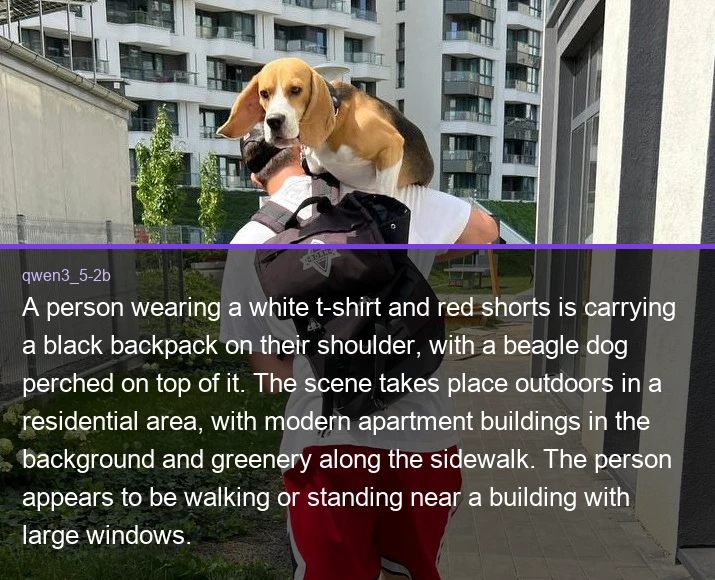
Set api_url to match your deployment target:
http://localhost:9001for a local Inference server.- Your Dedicated Deployment URL for a private endpoint.
You can train your own Qwen3.5 checkpoint on Roboflow and call it by its per-model {workspace}/{model-slug} ID (see Versions, Trainings, and Models).
Run Qwen3.5 with self-hosted Inference
Qwen3.5 can also be loaded directly with the inference package instead of being called over HTTP.
Install the package
pip install "inference[transformers]"Use inference-gpu[transformers] on a GPU machine.
Run the model
from inference.models.qwen3_5vl.qwen3_5vl_inference_models import (
    InferenceModelsQwen35VLAdapter,
)

model = InferenceModelsQwen35VLAdapter(
    model_id="qwen3_5-0.8b",
    api_key="YOUR_API_KEY",
)

image = "https://media.roboflow.com/dog.jpeg"
prompt = "How many dogs are in this image?"

preprocessed, metadata = model.preprocess(image, prompt)
predictions = model.predict(preprocessed)
result = model.postprocess(predictions, metadata)

print(result[0].response)
Qwen3.5 also supports a "thinking" mode, in which the model generates reasoning tokens before answering.
Execution modes in Workflows
When used in a Workflow, Qwen3.5 runs in one of two modes:
- Local execution: the model runs on your Inference server (GPU recommended).
- Remote execution: the model is invoked over HTTP on a remote Inference server.